
Stone Oracle
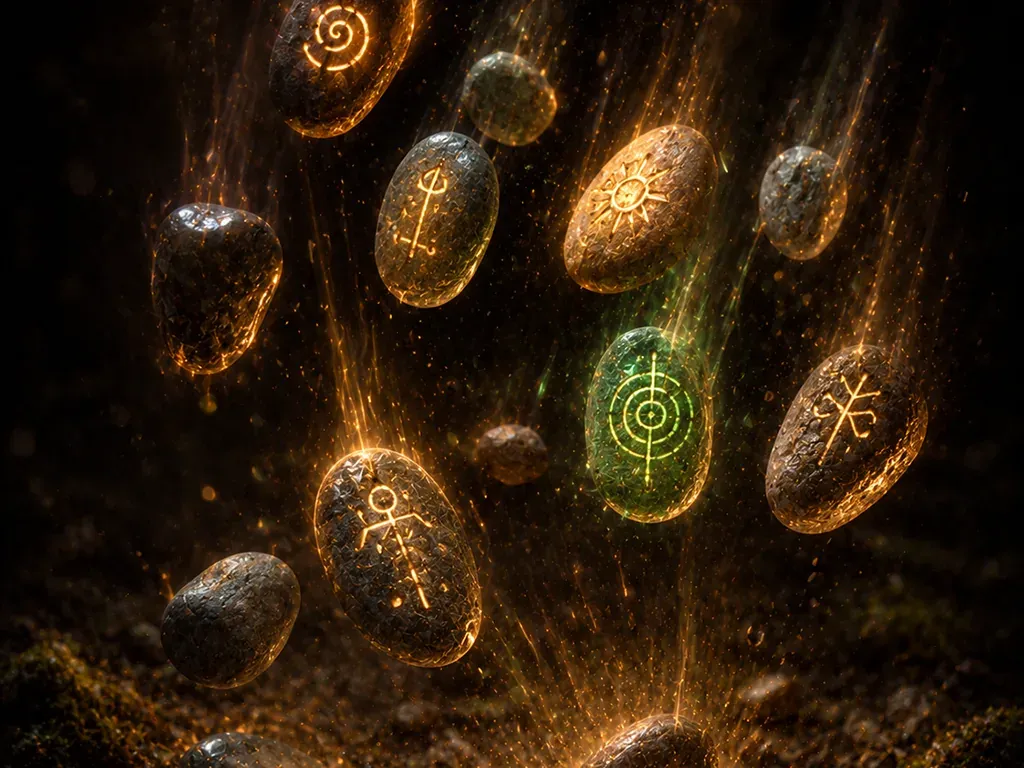
Draw from a collection of sacred stones and crystals, each carrying unique healing frequencies and ancient wisdom. Let the eart. Embeddable domain-locked widget, mobile-responsive.
Add this widget to your site
Free forever. Copy the snippet and paste it into any page — no coding required.
Lithomancy - divination by stones - is one of the older oracular practices, found in West African, Celtic, and indigenous American traditions. Each stone corresponds to a sphere of life or a planetary influence, and the pattern they fall in reads as a map. The Stone Oracle takes this principle and brings it to a clean digital format: you draw your stones, they fall, and the pattern is read across the positions that matter for your question.
How it works
Choose the number of stones for your reading - three for a focused question, seven for a fuller life-map. Each stone is drawn from the oracle's set, each corresponding to a different domain: love, work, health, money, hidden matters, past influence, and what's coming. The stones fall in a pattern, and the reading interprets both which stone landed where and how they relate spatially.
Understanding your result
The reading works on two levels: the stone itself (what domain is active) and the position (where in your life's terrain it's landing). A stone corresponding to hidden matters falling in the 'what's coming' position reads differently from the same stone in the 'past influence' position. The spatial relationship between stones - which are near each other, which are isolated - adds a third layer of meaning. Stones touching are in dialogue; isolated stones are operating alone.
Frequently asked questions
Which tradition does this follow?
The stone-to-domain correspondences draw from multiple traditions, synthesized here into a coherent single system. It's not a reproduction of any single traditional lithomantic practice.
What are the stones in the oracle set?
The set includes stones corresponding to: love, career, finances, health, family, hidden matters, travel, spirit, and major change. The full set and their individual meanings are shown before your reading begins.
Can I use this for yes/no questions?
The stone oracle works better with open questions about situations than with binary yes/no questions. For yes/no, the petal oracle or coin cast tend to read more cleanly.
Is this a traditional practice or modern?
The concept is traditional; this implementation is modern. The stone-to-domain correspondences are adapted and synthesized rather than drawn from a single unchanged historical source.